Welcome to Everrûn
Please, indulge our guides at your leisure. Come back anytime.
The Mystic
The Land & Its People
The Arcane
Magic as you know it, but not entirely.
Table of Contents
The Arcane Well
Karsus’ Folly was a mistake felt through more than just Realmspace.
Every Torillian is at least familiar with the tale of Karsus, and the damage dealt to Faerun in the face of his hubris. Where their deities formed a loom to keep magic practitioners restrained, the greater powers of Everrûn forged something stronger, more rigid; The Arcane Well. Rather than being upkept by a single deity of the divine arts, The Well is a structure designed as a failsafe by the full Everrûnian pantheon in hopes that no mortal can usurp the natural balance demanded by the arcane.
Those devoted to a pledge, pact, or powerful being may find themselves accessing the Arcane Well in ways unlike the average mortal, as their connection is tethered through a parallel network – such as Midnight’s Hexloom, or The Dark Pool.
Unnatural spells cast through these alternative channels can be detected by their harsher effects, or unique colouration; e.g., a Hexbound casting Misty Step may disappear into a cloud of violet smoke, rather than the natural silver.
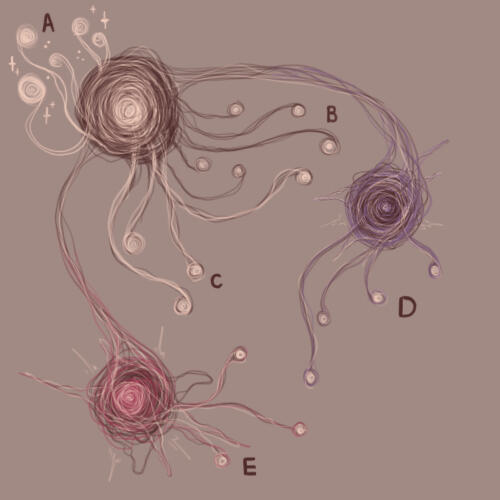
A: Gods, both Excellent and Vile, pour energy into the Arcane Well.
B. Mortal spellcasters who use natural magic without blessings.
C. Paladins, clerics, and warlocks who accept the gifts of the gods.
D. Hexbound; those who have given their lives for Midnight’s gifts.
E. Pactbound; those who have made deals with The Father of Lies.
Midnight's Hexloom
It seems the unmaking of the Weave had greater consequences than expected.
Early into Everrûn’s history, its gods splintered into two groups. It was believed that this was to satisfy the natural order of balance, and that these two halves did not act as moral compasses, but as planar counterweights. During the Age of Aspects, the young goddess was granted the forbidden knowledge that in another place, and another time, she was due to become the Mother of Magic, and would develop a grand structure that the realm she inhabited would rely on. Instead, here, on Everrûn, she was a domainless deity, as it was agreed upon that magic should not be in the hands of a single god.
It was this one single decision that birthed the Herald of Hexes, and in tandem – her Hexloom.
Midnight is a goddess of great envy; she does not wish to share her followers with the gods that she believes betrayed her. In that way, Hexloom users are akin to clerics, or warlocks, even – as their magic comes from an unwavering faith in Midnight’s reign.
The Dark Pool
To some, the Darker Arts were a temptation, to others, it’s a way of life.
After the Great Splintering of the pantheon, those of The Vile Communion found themselves subject of sacrilegious worship – with many of their followers offering sacrifices in the hopes of receiving dark blessings and favour. Some were repulsed by these mortal gestures, others revelled in them – Asmodeus being one of them. The Dark Pool was initially formed from the souls of sacrifice, harvesting whatever magic potential they carried, whether that be tomes, scrolls, or their very blood. Once it was strong enough to sustain itself, the Dark Pool grew into a source of magic in its own right, even surpassing Midnight’s Hexloom.
The Dark Pool acts as an alternative to The Arcane Well for wayward mortals to bolster their mystic capabilities – under the understanding that Asmodeus will demand a debt to be paid in equal measure. Many accredit the Age of Ascension to be the work of Asmodeus influencing Everrûn’s mortals into holy war, with the blood spilled fuelling his pet project; The Pool.
Unknown Arcana
The gods are able to control all that is known, however the unknown is a strange new world.
During the Age of Ascension, there was ample unrest amongst those of mortal descent – with many standing to challenge the gods, whether that meant dethroning them, or replacing them. The Arcane Well was designed to restrain the mystic output of a mortal, however it was designed with known magic in mind – which allowed the mages of Everrûn to circumvent it with their new spells and techniques.
This period saw the rise of what was considered High Magic, as the newly known arcana had far greater effects than the spells of old, which made them valuable resources, but also immeasurable weapons of war. Some were remembered by time, either through infamy or reverie – such as Leverick’s Infernal Storm, and Malico’s Grand Rejuvenation; many others, however, were lost to the unknown.
These secrets are now kept in Aureon’s ever growing Grimoire of Great Intellect, which is guarded securely – not out of tyranny, but out of fear of the impact they may have on Everrûn if ever relearnt. The ways of unknown arcana are not lost, and it’s quite common in artificer-rich cultures, such as Solaris, for the boundaries of the mystic to be pushed in the favour of discovery and innovation. It is theorised that if new magic were to be introduced to Everrûn’s ecosystem, the Arcane Well may require restructuring, as the influx of unlimited potential could spell havoc on the realm.
The Ages of Arcana
The many trials & Tribulations of Everrûn
The Age of Aspects & The Great Splintering
Everrûn’s First Conflict.
Everrûn was once a land without law, without order, and without gods. Despite the chaotic climate of the realm, it was its natural state, however even natural chaos demands an inverse; Everrûn demanded structure.
The Great Wheel served as its muse to pluck haphazard inspirations from, which resulted in Everrûn’s first monumental era: The Age of Aspects. During this period, deities from across space and time felt a displacement within their spark, as though they had lost a part of themselves, even if only for a moment. For the first time in Everrûn’s history, it had beings of celestial origin. Gods.
Over the course of a tenday, deities from Toril, Exandria, Eberron, and many more realms would flood to Everrûn, however none were their true selves – rather echoes of gods from the worlds they originated from. The Aspect of Aureon was one of the first, and acted as a doorman for those who followed; welcoming his new equals to this strange new world. Once the arrival of new celestials had halted, the Aspects founded their domains, with a surprising degree of decorum, which marked the beginning of the aforementioned “Age of Aspects.”
This was a relatively peaceful era for Everrûn, with minimal conflict, however the pantheon would start to show signs of fragility with the suggestion of The Arcane Well. Aureon proposed a means of controlling magic, not to dictate the free will of spellcasters, but to ensure a degree of equality amongst those who practise magic – citing Karsus’ Folly and the Spellplague as lessons not worth relearning. Many agreed, believing in its virtues as a mediator capable of separating mortals from accessing the power of gods, however a select few protested the concept – believing it to be restrictive and tyrannical.
Everrûn saw its circle of gods shatter between two groups, The Excellence, and The Communion. The Throne of Excellence was formed from those who chose to pursue The Arcane Well, however those who opposed the idea went on to form their own collective; a unification of gods that chose to remain unshackled, and free from those who once were their peers.
The Age of Ascension, & The Red Year
The darkest period in Everrûn’s history.
After the events of The Great Splintering, Everrûn returned to a period of tranquility, with its inhabitants revelling in the peace of their realm. The era of prosperity was only broken by, for the first time in centuries, the arrival of a new aspect. Dol Dorn, the Sovereign of Steel, had come from the far realm of Eberron, however unlike his predecessors, the deity was dead.
This spurred great outrage amongst the mortals, and great terror amongst the gods. To those of corporeal forms, they had watched a divine corpse fall from the sky, learning that their deities are fallible, and to those of celestial origin, they had witnessed an equal perish, with no immediate clues to the cause of death.
With no answers from the gods, and influence from Asmodeus, a select group of warriors and wizards began to develop a following of those who concluded that both halves of the pantheon were false idols that had replaced Everrûn’s original gods.
These naysayers had started to gain believers, who only bolstered their strength – introducing the first quasi-deities to Everrûn.
Some of which were capable of bending the arcane to their will, with figures such as Leverrick Lawson introducing new spells to the public domain. Some were capable of incredible good, such as healing spells that could span a city, or rituals that could dispel curses from coast to coast. Others, however, were used in the mortals’ war with the gods, and for the second time in Everrûn’s history – a god fell. Gond had sought to make peace with the ascended, and hoped compassion would be enough reason for them to lay down their weapons, and close the forges founded to build godslaying weapons. Unfortunately, he was not met with compassion, and Everrûn lost its God of Craft, marking the start of The Red Year.
The mortals that opposed the Qasi-deities were granted blessings and favours from the gods, with some even joining the war alongside their own deities, as both members of the Excellence and The Communion fought against their newfound common enemy.
It was decided that after their victory, the gods would retreat to Babylon – in fear that answering a mortal’s call would only result in sharing a fate with Gond. Communion with the deities became mostly restricted to The Slip, where neither god nor mortal are there physically, but spiritually. Some still make appearances in Everrûn, however they no longer roam the realm as if it were their home.
Celestials & The Spiritual
Everrûn’s pantheon, divine beings, and various fiends.
The Throne of Excellence
Gods, and those with Gifts worthy of deifying.
Those that belong to the Throne of Excellence are the deities and otherworldly beings that decided the Arcane Well was necessary in balancing Everrûn’s magic. It is commonly accepted that the gods of The Throne are entirely divine, however many others have reasoned that both halves of the Everrûnian pantheon act as one body – executing tasks that their inverse cannot.
Pelor acts as the Throne’s head, and often interacts with members of The Communion in hopes of creating a safer Everrûn, as allies, rather than adversaries.
The Vile Communion
Those who found divinity didn’t suit them.
The Vile Communion is not a name chosen by them, but a title history has decided to brand them with. Often considered betrayers, or rebellious sparks, the founding members of the Communion were simply those who disagreed with their peers on the matter of The Arcane Well. Each had their own reason to be against its construction, however it was their stark apprehension that unified them, and forever changed the Everrûnian pantheon.
While the Communion is made of many unsightly deities, they are often kept in check by Absolare – who holds a tight leash on the more unpredictable gods, such as Midnight, and Tharizdun. Otherwise, The Communion acts as a necessary evil, culling areas of abundance in the efforts of achieving equilibrium within Everrûn’s ecosystem.
Overrealms & Underrealms
It's a wild world out there.
Overrealms
Underrealms
Everrûn
The youngest realm of the waveless sea.
The Disparity
The forming of the world we know.
During the Age of Aspects, Everrûn was one continent, however the realm itself writhed in pain. These death throes marked the land’s portrait, as volcanoes scolded blemishes across plains, oceans overwhelmed forests, and tremors caused a great splintering. Those who were in the further regions drifted across Everrûn’s oceans, and formed new nations. Those who were inland, however, maintained the island that would become known as The Jubilee.
Natural disasters and calamitous events still occur, however their frequency has slowed substantially with Everrûn in a dormant state, and with the gods governing the realm.
The Old World & The New World
The reunion of Everrûn.
After The Disparity, Everrûn’s singular landmass splintered into several islands that saw new adaptations in its biodiversity to account for their altered place within the realm.
The people of The Jubilee were now fractured, and without a home to call their own, new nations would form under new banners, and new traits would manifest in their residents as they evolved to suit their surroundings.
Over the course of many centuries, these nations would recognise themselves as part of a greater continent, Pathos, and would believe themselves strong enough to face a new frontier; setting sail across the vast oceans and returning to their ancestors. On their voyage, they would find The Jubilee once more, alongside a plethora of cultures uncontacted for generations.
For many years, the Pathian people believed Everrûn to be complete with the rediscovery of their homeland, however ships started to wash onto the shores of The Jubilee. Scholars from Pathos came to the conclusion there must be more of Everrûn to explore, and that perhaps The Jubilee was not the northernmost landmass as they believed, and perhaps they had been looking at the land wrong. Pathos wasn’t south, it was east, which meant there must be more west.
Setting sail west this time, the Pathian voyagers traversed the waters until finally locating the westlands. Upon discovering this new region, Pathos dubbed it "The New World", and considered themselves "The Old World", however these names fell out of fashion as they were seen as reductive and insensitive.
The people of The New World weren’t hostile to their new neighbours, however they were very adamant about equal representation. They did not want to be treated as a discovery, or breakthrough; they were a people, a culture, and they deserved to be recognised as such. To make amends, the governors of Pathos would refer to them as Ethos, the title chosen for the continent by its people.
Babylon
They built castles to defend kings, and babylon to protect gods.
The Age of Ascension left the Everrûnian pantheon shattered, with many deities left as pale reflections of themselves, and many surviving as no more than a memory.
It was decided by both Excellent and Vile that there should be a sanctuary for the divine, a place where they may continue to fulfill their purposes without the risk of falling, as had many of their equals and peers. While searching the skies, seas, and subterrane, Aureon had looked where no other had; the stars. Looking upon Everrûn from beyond, he came to the conclusion that the realm was “leaking” magic into the aether, and that these wisps of the arcane could be cultivated into adjacent realms – still occupying the same crystal sphere without being physically connected by land.
Due to this region being a result of Everrûn’s “excess” magic, it had the potential to constantly grow, so long as the leak kept up. This not only meant that the domain’s terrain was constantly changing, but its very composition would alter to reflect its source – the arcane, but also belief.
For instance, Pelor’s domain over Babylon began with the Chapel of Radiance, a humble structure for the god to retire to in times of peace. As his influence began to prevail in Everrûn, the Chapel expanded, the belief in the Dawnfather grew – and so did his kingdom. Now stands a grand city of Solarian design, as they seem to be Everrûn’s most hearty believers in His Radiance.
Babylon has not lost mass to date, however it has been recorded by Aureon himself that regions of the Red Martyrs still exist, however have crumbled – due to the lack of a god to be followed or believed in. That said, the memories held in the hearts of other gods seem to be enough to maintain these fallen domains.
The Counting House
The house always wins, so why not rent the victories?
During Everrûn’s earlier years, Tzyros, Devil of Coin, found out about the realm between realms, that there were pockets of space between the mortals and their crystalline borders. Instead of answering to his master, he founded what he would dub The Counting House – an esoteric bazaar for devils to sell the souls they had collected in favour of deeds, material gain, or power.
Under the nose of the Dark Lord, Tzyros had created a black market for the abyssal.
Aragon, Devil of Harvest, would later find out what his subordinate was doing under the guise of “otherworldly matters”, and brutally slaughtered the fiend – taking his place as The Counting House’s lord. During his time as Keeper of The House, business was prosperous, and Aragon had expanded his practices to mortals, letting them indulge in devilish delights at the cost of their soul, their body, or other worldly valuables, such as the flesh of others. Aragon had done an incredible job at expanding his domain into a warlock refuge, however he had become too successful, which would be his downfall.
Aureon had recently discovered Babylon, another exterior realm like The Counting House – which, naturally, Asmodeus took interest in, wanting to bring the hells to Everrûn. Fortunately for him, and unfortunately for Aragon, he found where the rogue devil had been conducting business, and personally saw to it that the Devil of Harvest was flayed. Under Asmodeus’ reign, the warlocks of The Counting House were tethered to The Dark Pool, and a more standardised, institutional approach was taken to offering pacts and pledges to mortals.
Despite his intentions, the gods of Babylon refuse to act against Asmodeus, his realm, or his Dark Pool, as they come to the astute observation that offering a harsher alternative to the Arcane Well reduces the chances of mortals trying to seek even more destructive methods. By giving them a devil they knew, the gods didn’t need to worry about their subjects looking for one they didn’t.
The Slip
Careful, the soul can only travel so far.
After the Age of Aspects, the mortal world became disconnected from its gods; palaces were left derelict, shrines empty, and temples remained as dedications to the memories of the divine, rather than to their presence.
Faith wavered in the absence of the beloved deities, an effect that was felt by all within the pantheon, both Excellent and Vile. It was decided that a common ground should be found, or rather forged – which led to Aureon devising a rather grand plan to bridge the realms – allowing the gods communion with their devout without either party being physically present.
The scheme wasn’t without risk, a realisation the god would soon come to after his first attempt to create a midpoint. He believed that the realms were stacked, and that by poking holes in an overrealm, it would be possible to access, or create, an underrealm. Aureon wasn’t entirely wrong, however his theory wasn’t correct, what he had done was poke a hole in Everrun, and an abyss was formed.
He did in fact create an underrealm, however the souls of those who had entered couldn’t leave without forfeiting their lives as mortals. Aureon considered this a great failure, and abandoned the underrealm – allowing Elderran to claim it as his own, since he had found intrigue in the hopeless pit.
Years later, Aureon devised that the realms had to exist adjacent to one another, and that they could be traversed through a physical connection. With creation in his heart, the god constructed a meticulous bridge between the realms, with gateways that would restrict the travel of mortals to just Everrun, ensuring none would step foot on Babylonian ground. This structure was a huge success, with one of Aureon’s chosen being the first to commune with a god using this method.
The title of “The Slip” was a colloquialism that came from the aforementioned follower, as she would recount the experience as a “slip into another realm”. The term slipping would soon catch on with clerics who experienced frequent communion with their gods, and eventually the underrealm itself earned its name, which since hasn’t been changed.
Monarch's Rest
Alabaster's Crown jewel. est. 252PF.
After the Age of Aspects, the mortal world became disconnected from its gods; palaces were left derelict, shrines empty, and temples remained as dedications to the memories of the divine, rather than to their presence.
One of these deities was Alabaster, a domainless god whose smooth talking earned them an impressive following. Despite their lack of disciples in Everrun, the divine tycoon took it upon themselves to serve as a debt collector, loaning their powers to warlocks for their servitude. Off the clock, these pactbound souls were free to do as they please, however on the clock, they were loyal employees, and enthusiastic bellhops to the Monarch’s Rest.
Alabaster had a unique patronage method, offering both splendor and spells to those willing to sign on the line. No strings attached, just a 9/5 with paid holiday. Only one thing held them back though, and that was the Monarch’s Rest was popular; too popular for the amount of rooms lining its gilded halls.
That’s when the god had a wonderful idea; their peers had torn holes in reality, pulled at its threads to produce more space. Surely, for the right price, they could tempt another to do so the same. Alabaster offered Elderran an enticing deal to expand the underrealms, a deal he couldn’t refuse. One god’s trash became another’s treasure, as those indebted to Alabaster were offered to the Red Heaven, while the Monarch’s Rest expanded into the aether, endless halls for endless patrons.
The Red Heaven
The waters run red in the realm of the dead.
Before Babylon was founded, Aureon tore a hole in reality. That tear was mended, and did form the first underrealm, but many paid for his mistake. The casualties were incalculable, some settlements and cultures were wiped entirely off the map; names were lost to time, and souls were lost to the tear. The Sovereign of Knowledge did his best to maintain the cascading underrealm, enforcing stability through a siphoning of his own divine spark – however another deity offered to take his place, to his surprise, Elderran wanted to take on the responsibility.
As its herald, Elderran dubbed the space The Red Heaven, a bleak terrain shaped in his unique image. Scarlet waterways branched across a landscape of chalk white stone, crimson flora peppered the surface in inconsistent sprouts – with swords and shields more likely to be discovered than a single oasis. Despite its name, it’s no heaven, and it’s no hell, The Red Heaven simply is, and will continue to be.
It’s believed the realm is only accessible to those devoted to Elderran, or those slain by his followers. For the former, it’s a glorious, eternal conquest, and for the latter, it’s a spiteful existence until their souls expire. Those that live in the tainted lands of Vectara, however, are capable of performing this ritual too; it’s believed that the specific strain of spellslate that they cultivate has the capacity for realm travel. Strangely, it’s only capable of transporting souls that have either been killed with a weapon crafted with the mineral, or while wearing armour forged with it.
Halt, Traveller!
unfortunately, the archivists are still working on this article. Please come back soon.